
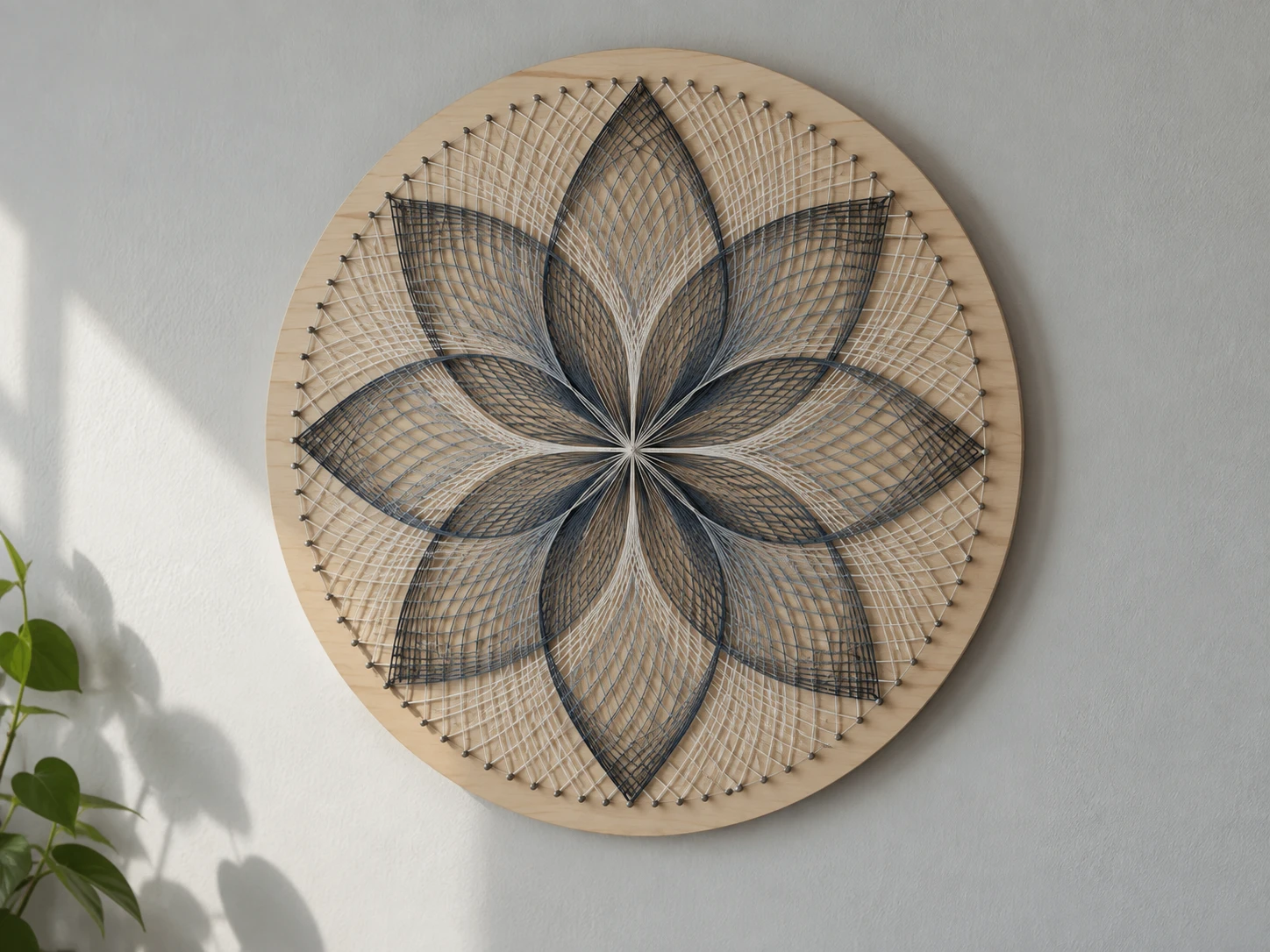
A repeated rule can become a picture
Geometric string art starts with the relationship between anchors. Repeated straight connections form envelopes that your eye reads as curves. You can explore this with a pencil and a circle of dots before working with thread. Maths Craft New Zealand provides original circular and heart-shaped string-art activities that explain this approach.
In the studio, open Image → Geometric studies and choose Layered mandala, Curve-stitch corners, Cardioid, Rosette bloom, Nephroid or Orbital weave to begin without uploading an image. Each study arrives with a suggested board and thread colour that you can change. Each study is generated by the same engine, so the result can be saved, printed and followed nail by nail. A circle is a useful first frame because it makes changes in the connection rule easy to see. The preview is still a numbered construction plan, so it can be saved, played through, and exported like a photo pattern.
Three ways to begin
| Study | Look for | Try first |
|---|---|---|
| Orbit | A regular rhythm of crossing chords around the frame. | A circular board and a single dark thread. |
| Cardioid | A heart-like curve emerging from repeated straight lines. | A circle, then compare its inner open space. |
| Rosette | A radial, petal-like arrangement of repeating connections. | Compare a lower and higher nail count at the same size. |
The finished shape is only half the story
Play through the generated instructions and watch how the image accumulates. A mathematically neat collection of lines is not automatically a single windable thread: the route between lines also matters. Follow the studio’s exported path rather than reconstructing it from a picture of the final design.
Patterns on concave outlines have fewer available routes because a taut thread must stay over the board. If an intricate silhouette makes the study feel uneven, compare the same idea on a circle or a broad convex polygon.
Make the open area part of the design
Use the empty center, the silhouette, and the spacing between lines as active parts of the composition. More thread can obscure the curved envelope you wanted to show. When comparing versions, keep the board size fixed and change one setting at a time. Save each promising version with a descriptive name.
Our geometric studies are starting points for flat boards. Three-dimensional ruled surfaces, independent anchor rings, and custom mathematical formulas are not generated here. Explore those ideas in the technique library.
Put it into practice
Try your image, inspect the preview, and save the pattern that works for your project.
Open the generator