These references show different approaches to working with thread. Each card explains what you can try in this studio today and where a new tool would be needed. The artists and institutions linked below are independent references; their work is not reproduced here.
01Portraiture
A thousand lines. One expression.
Make it in the studio
Layered dark thread turns crossings into tone. Petros Vrellis’s computational portraits show how a continuous route between perimeter anchors can resolve into a recognizable face.
Try it: choose a well-lit face, a quiet background, and a single dark thread. Compare a light study before adding more density.
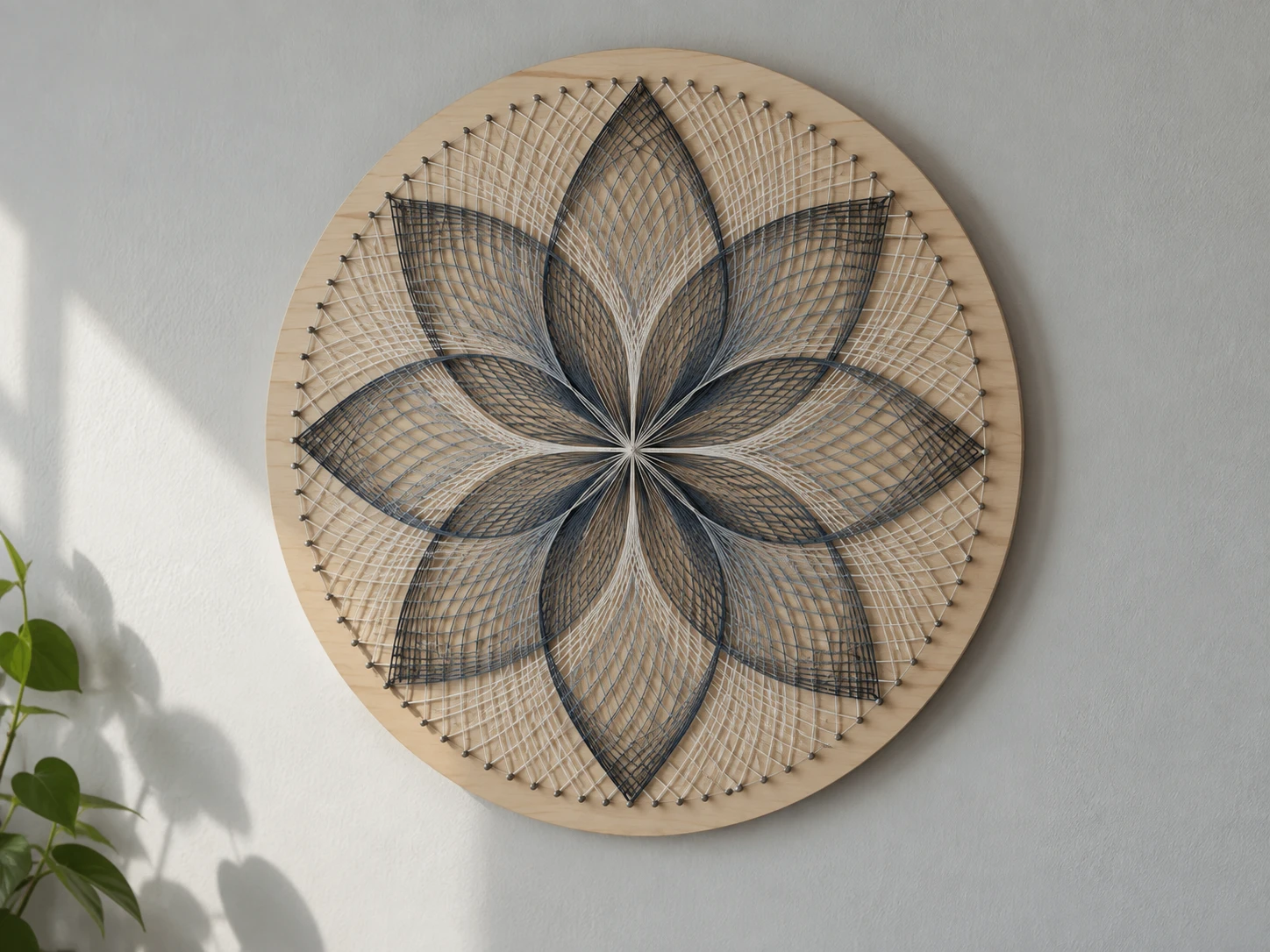
Repeated connections create curved envelopes and radial rhythm. Maths Craft New Zealand shares hands-on activities for exploring circular and heart-shaped string art.
Try it: choose Cardioid, Nephroid or Layered mandala under Studio → Image → Geometric studies, no photo needed. Begin on a circle, compare the open center, and watch the construction grow step by step.
Gabriel Dawe’s Plexus series offers a reference for exploring thread as a field of color. Our interest is in the relationship between neighboring hues and open space.
Try it: make a flat color study with a small palette and test real thread overlaps. The studio creates separate color paths; it does not plan a room-scale installation or simulate its lighting.
Naum Gabo’s Linear Construction in Space No. 2 uses Perspex and nylon monofilament. Its open structure is a useful prompt to think about what a thread can frame as well as what it can fill.
Try now: use a broad board shape and preserve light, open regions. Multiple anchor planes, different nail heights, and structural simulation would require a separate 3D tool.
Maurizio Anzeri sews geometric thread structures into found photographs. This is a different relationship between image and thread: the photograph remains part of the physical work.
What we could add: painted stitch regions and interior anchor groups for selective overlays. Today’s perimeter generator does not produce embroidery-hole maps or preserve a photo as a printed backing.
Erik Demaine, Martin Demaine, and Petros Vrellis explore letters as thread paths in their String Art Font project, including routes that trace a character continuously.
Try now: upload a bold letter as an image, or import a single closed letter outline (without counters such as the hole in “O”) as a custom SVG board. A full word composer, interior contours, and optimized letter-by-letter routes remain future work.
Give the same subject a different frame and see where the lines take it. Prepare one clean outline, import it under Studio → Board, and nails follow its contour.